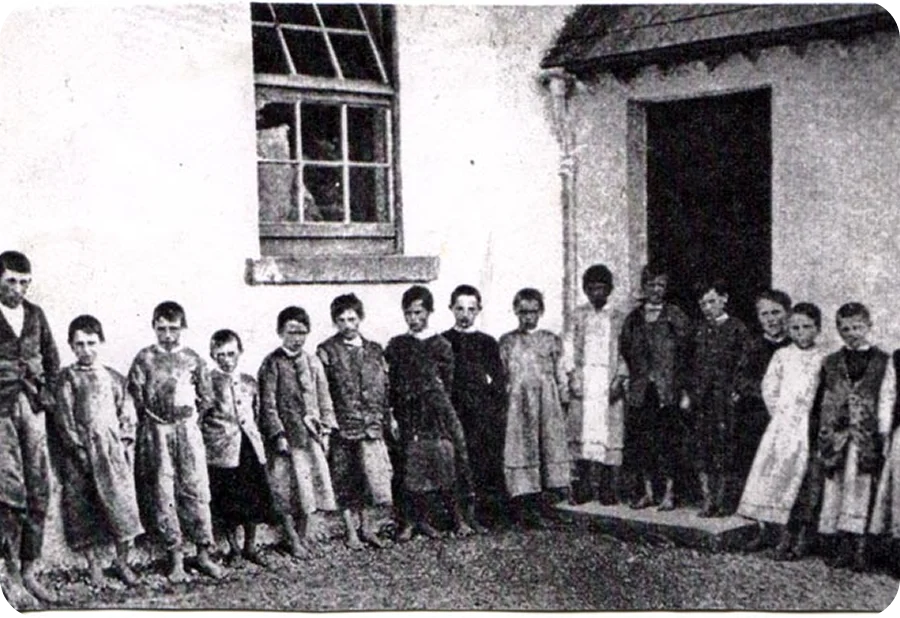
The following poem is based on an old photograph taken somewhere in Connemara, Ireland about 1900. It shows a group of schoolboys posing outside their one-room schoolhouse with the younger ones dressed in skirts—“to disguise themselves from the fairies.”
Five parts of this poem were published in The Kenyon Review in 1992. World events brought Christopher Woodman back to its themes a few years ago, the result being three new sections and a shift in focus.
The poem has become an important element in an unpublished book called LA CROIX MA FILLE: Hexes, Ruins, Riddles & Relics. What was originally the unpublished Part VII, for example, “Why Up So Late on the Village Green Then, Pietà, After All Those Flags, the Honor?” has now been expanded to 120 lines in itself. Not only is it one of Christopher Woodman’s most recent projects but one which, he says, most defines him as a civic being as well as a poet.
CONNEMARA TROUSERS
A POEM IN SEVEN MASKS AND AN ELEGY
I. Inventing the Skirt
See how the female fingers run
swiftly down the inside edge
opening the seam which once
defined each
                 thigh.

So freed the heavy fabric
peels back and heals,
melding round into a bell,
devolving back into
                         a skirt.

The old rubbed contours empty out,
the old distractions bleach flat,
only the slight discolorations tell
of flights and feuds and falling down
                                             the stairs.

Even the fly reduces to
a mere appendix healthy
in its cool unpenetrated calm,
a pocket placed beyond the reach
                                     of hands.

And watch the hem too how it cuts
each ankle off at the root
to build a base, shoveling in to raise
the sweet hill, the sacred
                           citadel.

The wrecked stance strides no more
but glides water-fueled along
the valley floor, the black soil
rich in flood-gate weirs
                       and quays.

Is all this new flesh
dunes blown full
or green rock welling up
to fill the muscle
                rifts?

Is this a healing back
to a time before
or the opening up
of a fresh
        wound?
II. In the Courtyard, Blooming
Wrapped so around
who needs
              light?

So let's unlace the lips
that bind the gates
within this fold
and squat to cradle
                              here--

Let's span the root-pale
fists that push and pulse,
the ancient day-old lips
that murmur floods and lap
and lap even to the ark,
to the planks and out
to the water-line moat
beyond which all events
are red-faced members
forcing in the flower
                              beds--

And still our shutters
leaning, louvres half-open
even to the warm night
                                   within.

Who could but draw
the knees up
and hold the
            breath?

Perhaps tomorrow morning
we can plant more hedges,
edge the paths and hem
the limits of this
                 labyrinth.
III. Reasons for Hiding
What curse compels this womb
to breed even when its sons
escape only to fling their banners
at the sun and crash back
spread-eagled on the hearth
amidst the broken
                       glass?

Who could have
the courage to
embrace again
such sharp
            seed?
IV. The Disguise
Then what are daughters for if
 not to cover sons?
V. Wearing the Skirt
And who would ever dare
to broach the secret of
those gawky boys standing
barefoot in the cobbled yard
                                        in skirts?

See how they squint back
at the hunchbacked figure
draped in crêpe who still
can photograph beneath
                                  that shroud.

How patched they are,
how sewn around and hemmed,
disguised in folds and fans
even to the chilblained
                              ground.

Is it that their genitals
are not yet gnarled and
dark enough to frighten off
the garden thoughts of
                              girls?

Or do their mothers shut
their eyes and let them be until
the hard itch can separate
their legs and make them
                                   slouch?

And who comes running then
with scissors and the thread
but the ruined fathers
to tailor out their falling
                          sons.

Then they can row the curragh,
cut the turf and sing until
old age will bring them
broken-backed and webbed
                                   within.
VIII. Elegy for Heroes like Heroines
And then we
                        all split.

Between the shroud
and the caul,
between the bell
and the word
we squirm and
we wriggle
                        and split.

But to be equally split
is not to be equally
                        parted,
for one remains cleft
while the other is
                        cloven,
one remains fissured
while the other is
                        forked.

Knees knit together
one loves like a fish
but rises and walks
                    like a man,
while the other
spread-eagled and burst
loves like a man
but lingers behind
                    like the sea.

So pity the mermaid
whose tail is unwoven,
how she strides split
stubborn and silent
                    like Deirdre
or Nausicaa,
eating nothing like Simone,
or clay like Camille, oh Anna,
how she hopes even
                    to the altar.

And pity the gamin
webbed in the skirt,
his members knit back
into one midnight bell,
how he minces,
                        he hobbles
like our Christy or Lawrence,
how he flutters on pinions
of radiance
            like Icarus
or dereliction
                    like his father,
laboring in the shadow
of his failure's designer,
how he chimes in the net
                        of the charmed.
CHRISTOPHER WOODMAN
Five parts of this poem, I, II, V, VI & VIII, were published in The Kenyon Review (vol. xiv, No. 3, 1992). Parts II, IV, & VII remain unpublished.