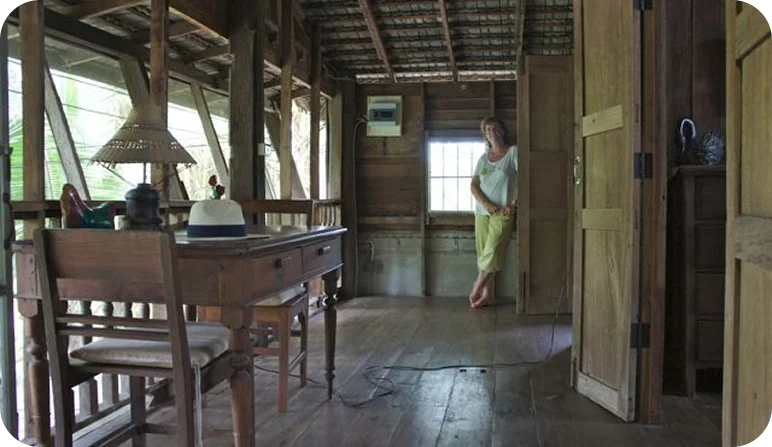
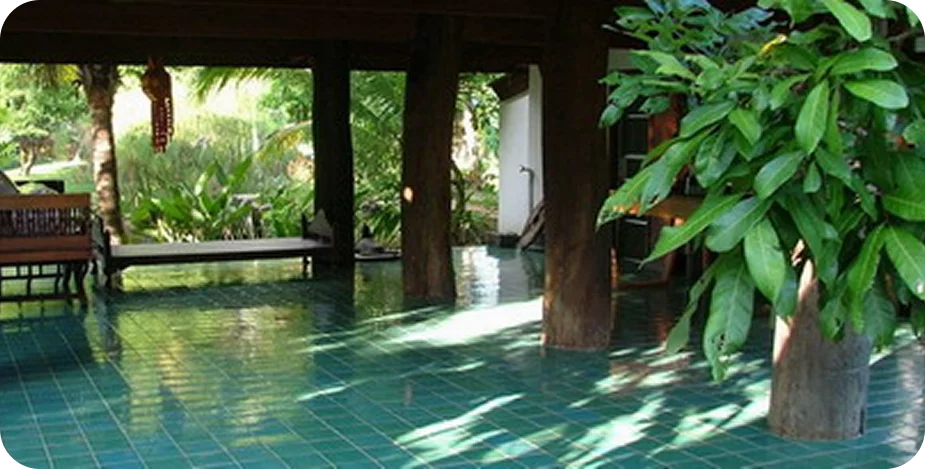
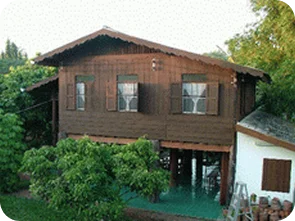
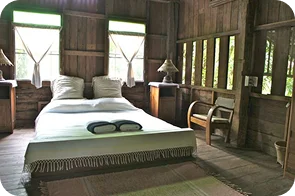
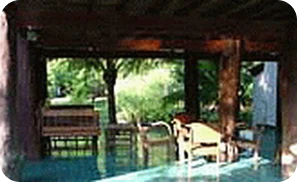
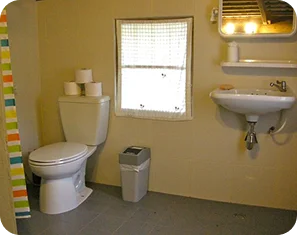
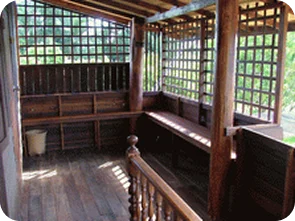
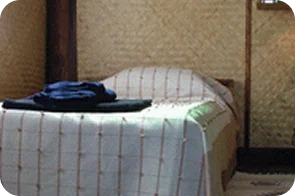
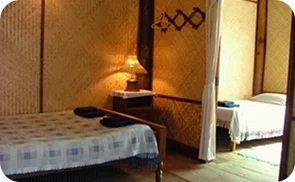
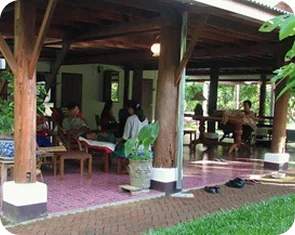
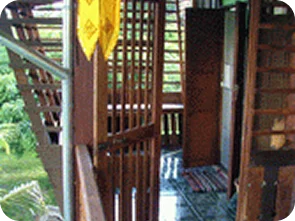
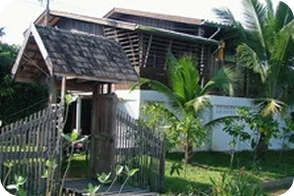
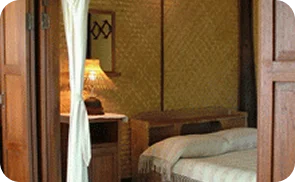
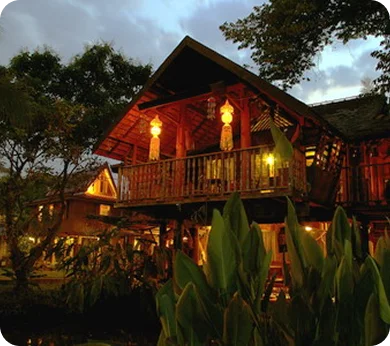
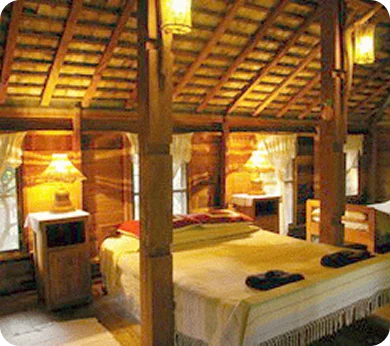
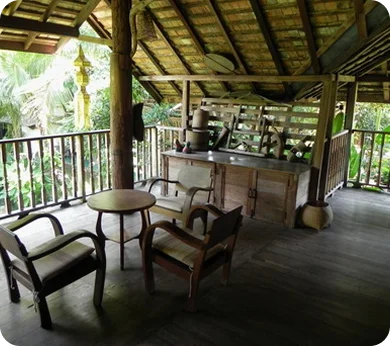
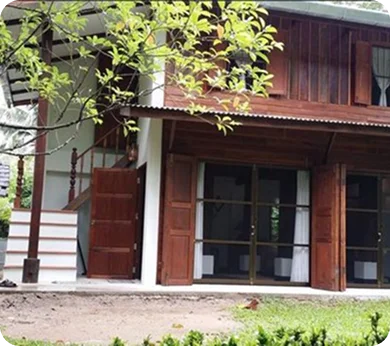
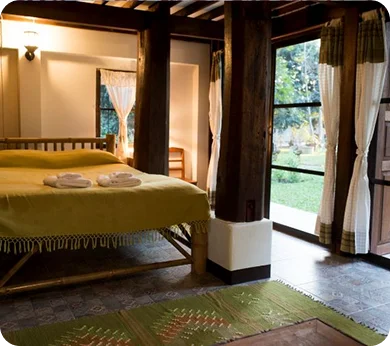
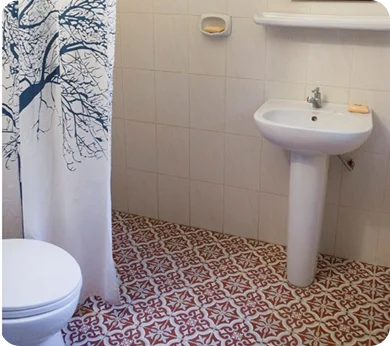
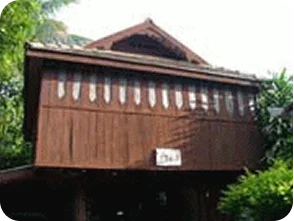
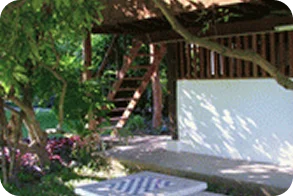
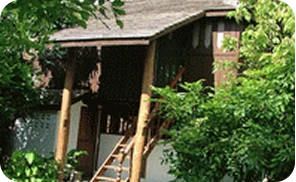
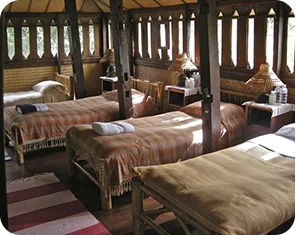
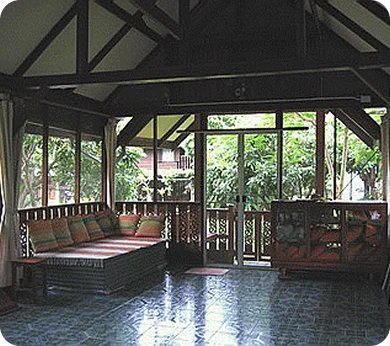
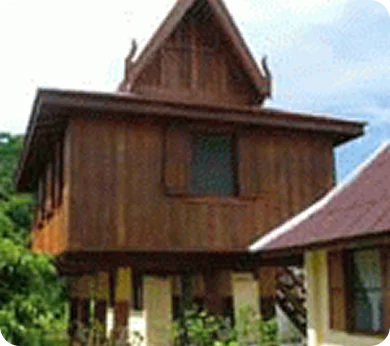
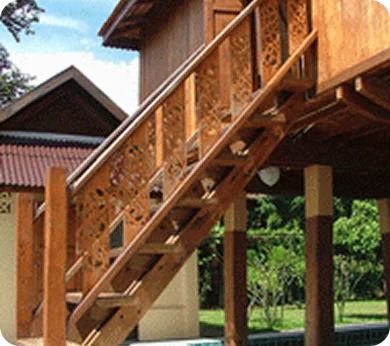
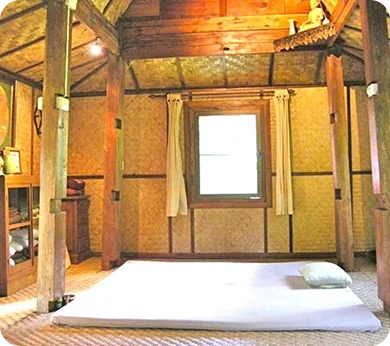
We offer 5 traditional dwelling houses arranged as in a rural Thai village around a pond. There are 11 bedrooms plus a dorm, all of which have windows without glass, overhanging roofs, wooden shutters to close during the Monsoon thunder storms, and shaded porches. The houses are all old farmhouses on stilts but each one has hot showers and modern toilets down a short flight of stairs. There are also open social areas downstairs with mats, tables, chairs and, of course, the traditional settees for lounging. In addition there is a small kitchen for you to make tea and coffee—and a fleet of bicycles to take you out in the rice.
You must remember that the climate is very mild here and that a bedroom is just for arranging your clothes and for sleeping. Indeed, that’s all you will do there as from the Yoga at 7am until retiring for the night after dinner at 9 or 10pm you will be outside regardless of the time of year — there is no glass in our windows and no walls closing in our eating, relaxing and working spaces. And of course there is no central heating either.
What follows is a brief introduction to our houses which range from a 4 bed dorm with a shared downstairs bathroom to a private old wooden house with a private upstairs bathroom. The latter, called Baan Jung Kaew, has a large porch extending out over our lotus pond. It can be booked by a couple, two friends, a family with children, or even by a singularly lucky single person!
Beside students and their partners, our guests include individuals of all ages, couples and whole families who come to us for a variety of reasons: the beauty of the place, the good company around our big table, the herbal steam baths, massages and other therapies, and of course the opportunity to relax, catch up, recover, or get on with some personal project. There are no coffee shops, restaurants, bars or even 7/11s around us, so you can’t just walk out our door for urban refreshment. On the other hand, we have rice fields, the river, small local temples and earth-markets everywhere, and very likely you will be the only foreigner wherever you go, on foot or by bicycle. It’s rough, simple, and still a little too messy, but it’s also somehow more than just there, and much more than beautiful.
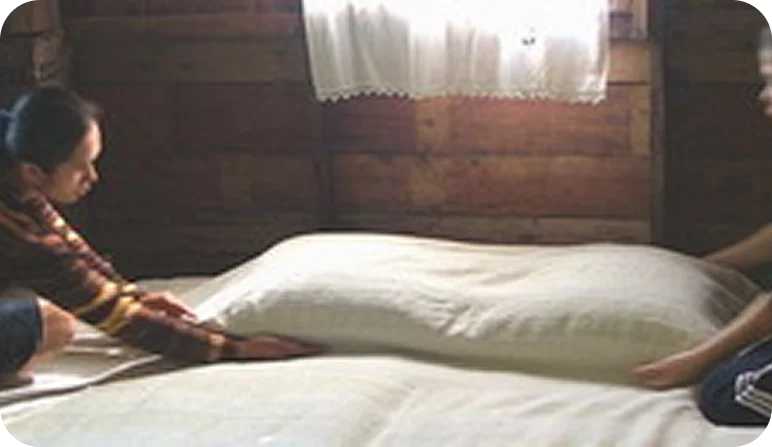
Our largest building, Baan Uii Kham has a red tiled ground floor with three toilets, three hot water showers, and lots of tables and chairs. The Baan Hom Samunphrai office is also located here. There are 3 staircases leading up to 3 separate porches, each of which connects to two rooms, 1 with a double bed and the other with a single.
Baan Jung Kaew is our oldest building. It used to be our only accommodation with a hot water shower and toilet directly attached to a bedroom, and still has the largest and most private of all our porches extending right out over the pond. A joy for a couple, it’s also sometimes chosen by close friends who like to talk all night. There is a double and a single bed, and it’s a pleasure for a family. Couples always have priority for it, needless to say, but if we have room it can even be booked by a single person at no extra charge.
Baan Mai was completed just two years ago, and we did it because we wanted to have available more private bathrooms for those who really needed them. Built around an antique rice barn with huge teak posts, there are two floors, each with a modern shower and toilet. The upper bedroom with 5 windows has two separate beds between the teak pillars, and the ground floor a large double bed with folding screen doors that open out onto the garden. (There is a surcharge of 100 baht per person when either floor is booked by a single person. But we can only offer this option when we have room, and, needless to say, guests with special needs get priority).
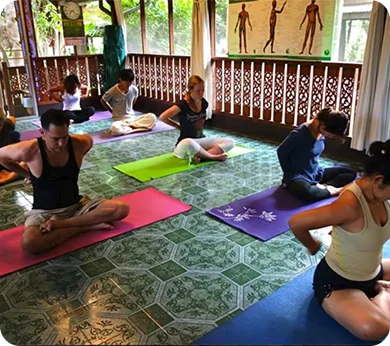
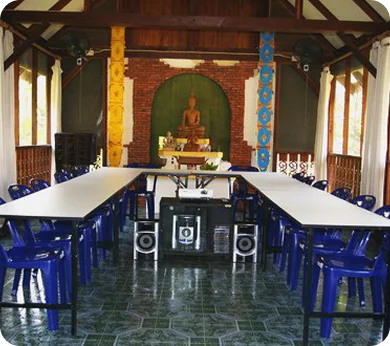
Baan Rusi is our primary workspace. It is a large Lanna-style sala named after the mysterious forest hermit and teacher known as Rusi. There is a shrine at one end of the space with a large teak Buddha surrounded by other sacred images and artifacts — a treasure house, in fact, always adorned with fresh flowers, incense and offerings. And just below the Buddha sits Shivaga Komarapat, the Buddha’s personal doctor, and to his left an alabaster image of Rusi, the forest hermit — he was the one who taught Shivaga Komarapat the yoga called Rasidaton, the movement that begins all Homprang’s classes.
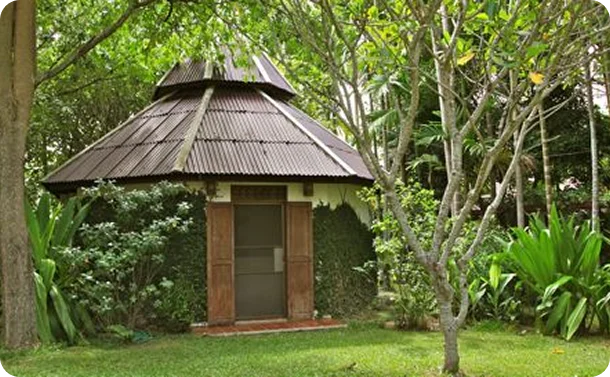
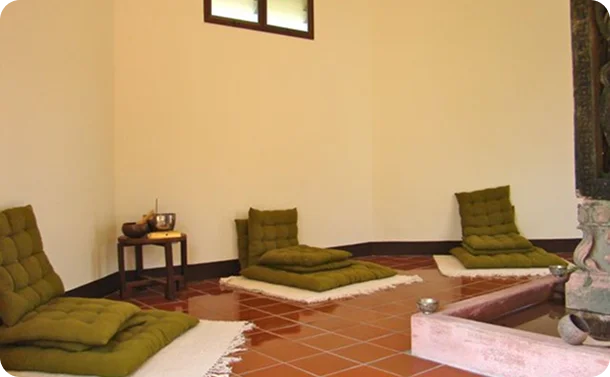
The Sala Samathi is an octagonal meditation space we had been contemplating for years but could never quite get our minds around. We dreamed of a space that would be useful as well as beautiful, practical as well as spiritual and, above all, one that would not exclude any of the extraordinarily diverse body of guests and students we’re blessed with from Mormons to Urighurs to Sangomas, Sikhs, Lebanese Catholics, Palestinians, and even one seriously Buddhist Baptist.
There are no specifically religious images inside the space, just a fountain with moss and ferns as green as the cushions against the bare white walls. Indeed, all four elements play around you, earth, air, fire and water, and we make it very clear that the space is for anything you feel moved to do in it too — it’s a wonderful place for a chat or a nap, or for reading a book by yourself or singing or playing your dulcimer or your body in yoga. And of course its perfect for Vipassana, or any other mediation for that matter — and needless to say, you meditators do get priority, don’t worry!
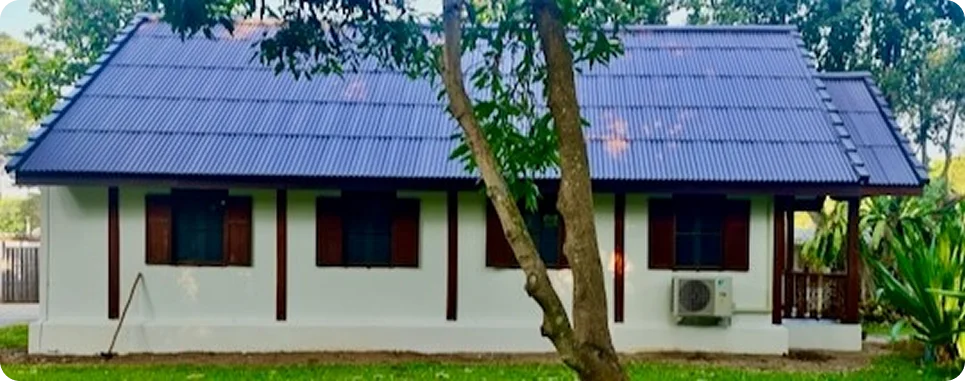
our new Training Sala with Air Con and Air Purification.